

Quick Answer
Does reading FLASH and EEPROM mean an ECU can be cloned? No. A successful read confirms what the tool exported in that session. It does not establish that the export contains every region required for a clone or that those data can be written to a compatible replacement. Confirm the clone procedure for the exact original and replacement controllers. [R05] [R10] [R12]
Scope and evidence
This article explains general principles for professional repair and replacement planning. It is not a wiring guide, a security-access procedure or a vehicle compatibility list. MCU examples illustrate architectures; they do not identify the memory layout of an unspecified ECU. Numbered references identify primary sources; workshop decision criteria are editorial synthesis, not quotations from a universal repair standard.
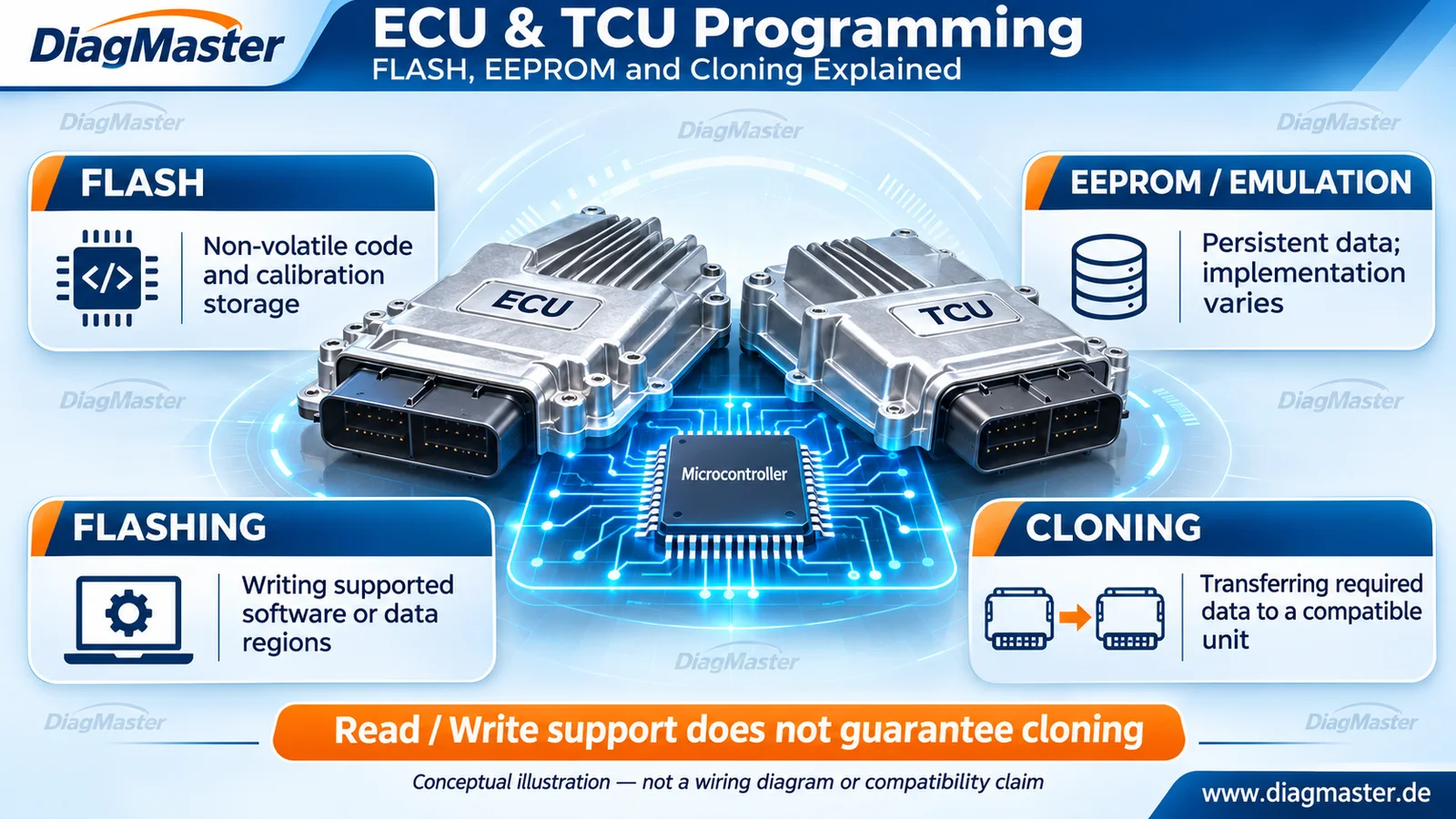
Figure 1. Conceptual controller and memory illustration. Housings, connectors and circuitry are illustrative, not an OEM layout. Definitions and limits: R03, R04, R05 and R11. Original DiagMaster editorial artwork.
1. ECU, TCU and MCU: what each term means
ECU means electronic control unit. In engine-service usage it can also mean engine control unit; this guide uses “engine ECU” when that narrower meaning is intended. TCU means transmission control unit, also called a transmission control module (TCM). Engine and transmission controllers serve different control functions; their names alone do not specify how either is programmed. [R06]
MCU means microcontroller unit: a chip combining processing cores, memory and peripheral functions. An ECU is the assembled controller; an MCU is one component within it. NXP’s S32K1 family is an example of an automotive MCU family with processing, memory and peripheral options. The exact chip and controller revision matter more than a broad vehicle-brand label.
2. FLASH, EEPROM and emulation
Table 1. Memory terms and practical limitsTerm | Technical meaning | Service boundary |
|---|---|---|
FLASH (flash memory) | Electrically programmable non-volatile storage; rewriting commonly involves erasing a page or sector. | May hold code, calibration or persistent data. Erase size and writable regions are device-specific. |
EEPROM | Electrically erasable programmable read-only memory; retains data without power. | True EEPROM can support byte/page writes without a separate host-issued page erase; write granularity depends on the device. |
EEPROM emulation | Software manages persistent variables in flash to provide EEPROM-like storage behavior. | A tool’s “EEPROM” file may represent logical data rather than a separate EEPROM chip. |
Program flash / data flash | Architecture-specific names for non-volatile storage areas. | A memory-area label does not prove that a tool can read, write or migrate that area. |
RAM | Volatile working memory used during execution. | A flash backup should not be assumed to preserve live RAM state. |
ST AN4894 describes flash-based EEPROM emulation and its erase-management requirements. ST’s M95640-A125 provides a contrasting example of true automotive serial EEPROM with byte/page writes. Infineon documents separate protection mechanisms for AURIX memory regions. These examples do not establish where any particular vehicle stores identity or learned values. [R03][R05]
Data type is not a memory address
Data categories do not identify physical addresses. Do not assume “FLASH = software only” or “EEPROM = immobilizer only.” Confirm the exact controller’s memory layout. [R03] [R05]
Firmware is the controller’s embedded software. Calibration data supplies parameters used by that software, such as control maps and limits. Code and calibration may occupy different regions; a calibration update does not necessarily replace the application code. These are logical distinctions, not a universal storage layout. [R15]
3. Programming, flashing, coding and cloning
Table 2. Separate the task from the storage technologyOperation | Working definition in this guide | What it does not establish |
|---|---|---|
Programming / reprogramming | Writing supported software or data; in OEM service this often means installing selected software/calibrations. | Does not imply access to every memory region. |
Flashing | Programming flash memory, usually through a controller-supported update path or an approved programming interface. | Does not necessarily replace EEPROM, identity or all software regions. |
Coding / configuration | Selecting supported variant settings for an application. | Not synonymous with replacing the firmware image. |
Adaptation / relearn | An OEM-defined procedure to learn or initialize operating parameters. | Not necessarily a raw memory copy. |
Cloning | Transferring the required data from an original controller to a compatible replacement through a supported procedure. | Does not mean every physical bit or protected region is copied. |
Recovery | Restoring operation through a supported recovery path after a failed or unsuitable software state. | Not guaranteed by possession of a backup file. |
These are explicit editorial definitions; vendors may group functions under different menu names. Alientech describes cloning for supported controllers and compatible replacement units. Its support legend lists reading, virtual reading and cloning separately. Accordingly, this guide treats each function as a separate capability to verify. [R12]
4. What a diagnostic programming path can include
ISO 14229-1 specifies application-layer diagnostic services independently of the data link. The public ISO catalog lists edition 4, ISO 14229-1:2026, published in June 2026. The catalog does not establish which services a particular production ECU implements. [R06]
For a concrete, publicly accessible implementation reference, AUTOSAR Classic Platform R21-11 describes RequestDownload (0x34) to initiate a download, TransferData (0x36) to move data, and RequestTransferExit (0x37) to terminate the transfer. “Download” here is data transfer toward the ECU/server. These services illustrate part of a programming path; they are not a universal executable flashing recipe. Sessions, authorization, erase routines, validation and reset behavior depend on the implementation. [R07]
J2534 is an interface standard, not a firmware library or cloning license. The cited SAE J2534-1 scope describes a PC-to-vehicle interface and expects vehicle-manufacturer software to control actual reprogramming. Confirm the OEM application’s supported interface, software, subscription and controller coverage for the intended job. [R08]
5. Actual read, virtual read and backup
Table 3. Read the file description before calling it a backupFile or action | What it represents | Limit to record |
|---|---|---|
Identification / ID | Reported controller references and software identifiers. | Identification alone is not a memory backup. |
Actual / normal read | Data read from the connected ECU within the supported scope. | The read may expose selected regions rather than all device storage. |
Virtual read | A stock file obtained from a server using controller software identification, as AutoTuner defines it. | It does not capture the connected ECU’s current modified file or unique persistent state. |
Backup / full backup | A manufacturer-defined saved data set. | Check the documented included regions, exclusions, format and restoration conditions. |
Verified archive | A retained file set with provenance and integrity records. | A matching archive hash detects file changes; it does not prove ECU compatibility or restorability. |
AutoTuner distinguishes an actual ECU readout from its server-supplied virtual read. Its separate backup documentation describes a backup containing MCU memories. That wording is product-specific: it should not be generalized to every tool’s “full read” or to all components on a controller board. [R09] [R10]
For a defensible service record, retain controller identification, tool/software version, access mode, operation log, date, file sizes, documented memory coverage and archive hashes. This is an editorial record-keeping recommendation. A failed read or inaccessible region must remain an explicit gap; neither file size nor a familiar filename resolves it.
6. Why cloning is conditional
Cloning depends on both controllers and the documented procedure. Match the original and replacement part numbers and hardware/software identifiers. Use the protocol entry for the exact tool, software version and connection mode. [R11] [R12]
Available evidence | What you can conclude | What to verify next |
|---|---|---|
Virtual read | In AutoTuner’s documented workflow, this retrieves a stock file matched to the reported software number. The source ECU’s current contents remain unverified. [R09] | Check whether the job needs an actual read and which original data must be retained. |
FLASH and/or EEPROM exported from the original | The files establish which regions the tool reports exporting. Required data may sit outside that export, and target write access remains unverified. [R05] [R10] | Compare the file manifest with the documented clone requirements. Check required regions, any documented protection limits and the replacement’s write eligibility. |
Documentation lists read/write only | Read/write is documented for the listed controller or memory regions in the stated mode. The clone status is cloning unconfirmed. [R12] | Look for an explicit clone function and supported original/replacement pairing for the exact tool and software version. |
Manufacturer explicitly supports the original/replacement combination | Cloning is documented for that pairing under the stated conditions. This establishes support on paper; the actual write and vehicle operation still require verification. [R11] [R12] | Match both module identifiers, the tool/software version and connection mode. Check whether coding, adaptation or initialization is required afterwards. |
Record any vehicle-side coding, adaptation or initialization the documented replacement procedure requires. Where the manufacturer has not confirmed the exact pairing and workflow, record cloning unconfirmed. A successful read or write does not verify the completed repair. [R05] [R11] [R12]
7. Checksum, CRC and digital signature
Checksum is a broad term for a value calculated from data for checking purposes; specify the algorithm and covered region. A CRC (cyclic redundancy check) is a checksum suited to detecting accidental data changes. It is not a cryptographic hash and does not authenticate software origin. [R13]
A digital signature uses cryptography to support integrity and origin authentication. Consequently, correcting an ordinary checksum or CRC does not create a valid manufacturer signature. An ECU may apply multiple checks, and a write-complete message cannot establish that software will be accepted at startup or function correctly in the vehicle. [R14] [R05]
8. Connection mode and capability are separate
Table 4. Terminology follows common manufacturer usage; consult the protocol instructionsMode | Common tool-industry usage | Capability boundary |
|---|---|---|
OBD | Access through the vehicle diagnostic connector. | Writing may be available when actual reading or cloning is not. |
Bench | Access through the controller’s external connector, commonly without opening its housing. | Direct connection does not imply unrestricted memory access. |
Boot | A controller/MCU-specific low-level access method, commonly requiring an open controller. | No universal pinout, security exemption or complete-read guarantee. |
Alientech uses OBD, Bench and Boot to describe these connection arrangements, and lists function availability separately by connection. Select the documented mode for the exact controller; a cable or adapter does not itself supply missing protocol support. [R12]
9. A documented repair decision sequence
The following checklist is editorial synthesis for planning, not a substitute for the applicable service procedure.
- Identify: Record vehicle and controller identity, part numbers and hardware/software revisions. Define whether the task is an update, repair, replacement or data migration.
- Confirm support: Check the exact operation, connection mode, software version, license and required adapters. Obtain a documented answer for any missing compatibility detail.
- Prepare: Follow the OEM/tool instructions for supply equipment, voltage, connections and communication stability. There is no single programming voltage suitable for all vehicles and loose modules.
- Preserve: Where supported, capture original data and logs before changing it. Confirm which regions can actually be restored.
- Operate: Use the specified software and procedure. If an operation fails, preserve the failure details and follow the documented recovery path before further writes.
- Verify: Check final software identification, diagnostics and required functional/relearn results. Record the outcome and unresolved faults before closing the repair.
An OEM example explains why generic recipes are inadequate: GM bulletin N232428540-02 requires VIN verification, stable battery voltage and specified programming support equipment, and warns about interruption. It concerns specified 2023 Cadillac LYRIQ vehicles. It is cited as a historical example of procedure-specific constraints, not as a current instruction for other ECUs/TCUs. [R15]
10. Frequently asked questions
Is FLASH the same as EEPROM?
No. Both are non-volatile storage, but their erase/write behavior differs. EEPROM emulation uses managed flash to provide persistent-variable storage; it does not prove that a separate EEPROM chip exists. [R03] [R04]
Does a virtual read back up the connected ECU?
No. In AutoTuner’s terminology it retrieves a corresponding stock file from a server. It does not preserve the ECU’s current modifications or unique data. [R09]
Does read/write support guarantee cloning?
No. Read/write support describes the listed operations for that controller and mode. Confirm an explicit clone procedure for the original and replacement pair, the exact tool/software version and connection mode, and any required post-write coding or initialization. Without manufacturer confirmation, record cloning unconfirmed. [R11] [R12]
Can a full backup copy protected or OTP regions?
A “full backup” label alone cannot establish whether a protected or one-time-programmable (OTP) region was read or can be migrated to a replacement. Read and write permissions are separate; a readable region can be non-writable. Compare the backup manifest with the controller and tool documentation for the required regions and target permissions. [R05] [R10]
Does checksum correction satisfy a digital-signature check?
No. An ordinary checksum or CRC and a cryptographic signature provide different assurances. Recalculating the former does not generate the latter. [R13] [R14]
Can a J2534 device program every ECU or TCU?
No universal coverage follows from J2534 alone. Actual reprogramming depends on the OEM application, supported interface and controller procedure. [R08]
Does “write complete” mean the vehicle is repaired?
No. It reports the write operation’s outcome. The required diagnostic and functional checks, and any specified coding or relearn, still determine whether the repair is complete.
What information should I send to technical support?
Send the original and replacement part numbers and hardware/software identifiers, the tool and software/protocol version, the connection mode, and the intended operation. Include the read type (actual or virtual), regions exported, the exact error or failure stage, and relevant logs. Note any documented coding or initialization requirements and preserve the original files. Ask support to confirm the exact pairing and procedure. [R09] [R10] [R12]
References
Primary sources checked on 17 November 2026. Catalog/abstract access is distinguished from full-text access. Reference numbers are stable citation labels for this edition. No source listed here endorses this article or certifies a product’s compatibility.
[R01] Bosch Mobility. Control units. Web page; engine and transmission controller categories. Accessed 2026-11-17.
Use and limit: ECU and TCU roles; not evidence of tool compatibility.
[R02] NXP Semiconductors. S32K1 Microcontrollers for Automotive General Purpose. Overview and Product Details / Features. Accessed 2026-11-17.
Use and limit: MCU processing, integrated memory and peripherals; device-family example only.
[R03] STMicroelectronics. AN4894 — How to use EEPROM emulation on STM32 MCUs. Main differences between external and emulated EEPROM; Table 2; Implementing EEPROM emulation / Principle. Accessed 2026-11-17.
Use and limit: Flash erase management and EEPROM emulation. Explains a memory principle; does not establish an automotive ECU memory map.
[R04] STMicroelectronics. M95640-A125 — Automotive 64 Kbit SPI bus EEPROM. Description and All features. Accessed 2026-11-17.
Use and limit: True, byte-alterable EEPROM; byte/page writes; not a universal ECU component.
[R05] Infineon Technologies. AURIX TC3xx Family User’s Manual, Part 1. V2.0.0, February 2021; §6.5.4 Security; printed page 6-140. Accessed 2026-11-17.
Use and limit: Read/write, OTP and HSM protection. Relevant section indexed by search; complete PDF download was not available for local review.
[R06] ISO. ISO 14229-1:2026 — Road vehicles — Unified diagnostic services (UDS) — Part 1: Application layer. Edition 4, June 2026; public Abstract and Life cycle. Accessed 2026-11-17.
Use and limit: Application-layer scope and edition status only. Paid normative text was not accessed.
[R07] AUTOSAR. Specification of Diagnostic Communication Manager. Classic Platform R21-11; §§7.6.2.19–7.6.2.22; printed pp. 202–206; SWS_Dcm_00496, 00502, 00505. Accessed 2026-11-17.
Use and limit: RequestDownload, TransferData and RequestTransferExit. Historical implementation reference, not a claim of conformance to ISO 14229-1:2026.
[R08] SAE International. J2534-1_0500_202201 — Recommended Practice for Pass-Thru Vehicle Programming. Issued January 5, 2022; public Scope; DOI 10.4271/J2534-1_5_00. Accessed 2026-11-17.
Use and limit: PC-to-vehicle interface; vehicle manufacturer software controls actual reprogramming. Paid normative text not accessed.
[R09] AutoTuner. Virtual Read vs Normal Read. Régis Thomas; June 6, 2025; Virtual read / Normal read. Accessed 2026-11-17.
Use and limit: Server stock file versus actual ECU readout; definitions specific to this manufacturer.
[R10] AutoTuner. Backup file. Régis Thomas; May 6, 2025; What is a backup file?. Accessed 2026-11-17.
Use and limit: Illustrates a manufacturer-defined MCU memory backup; not a universal definition of a full ECU dump.
[R11] Alientech. KESS3. Connections; ECU, TCU and cloning / Can I duplicate a control unit?. Accessed 2026-11-17.
Use and limit: Connection descriptions and cloning restricted to supported, compatible units.
[R12] Alientech. KESS3 & Powergate Vehicle List. Legend / Connections / Connection Functions. Accessed 2026-11-17.
Use and limit: Separates connection mode, reading, virtual reading and cloning availability; no individual ECU support row certified here.
[R13] NIST CSRC. cyclic redundancy check (CRC). Glossary; definition sourced to CNSSI 4009-2022 / IETF RFC 4949 v2. Accessed 2026-11-17.
Use and limit: CRC detects accidental changes; it is not a cryptographic hash.
[R14] NIST CSRC. digital signature. Glossary / Definitions. Accessed 2026-11-17.
Use and limit: Cryptographic integrity and origin authentication; distinct from CRC.
[R15] General Motors, hosted by NHTSA. N232428540-02 — Multiple Module Reprogramming. Revision 02, August 2024; Service Procedure, printed p. 2 (PDF p. 3). Accessed 2026-11-17.
Use and limit: VIN matching, stable power, correct support equipment and interruption risk. Applies to specified 2023 LYRIQ vehicles; not a generic ECU procedure or current campaign eligibility statement.
About this guide: Prepared for DiagMaster Technical Support. This is a referenced editorial explainer, not an OEM-issued bulletin, a certified repair procedure or a claim of independent engineering validation. www.diagmaster.de.